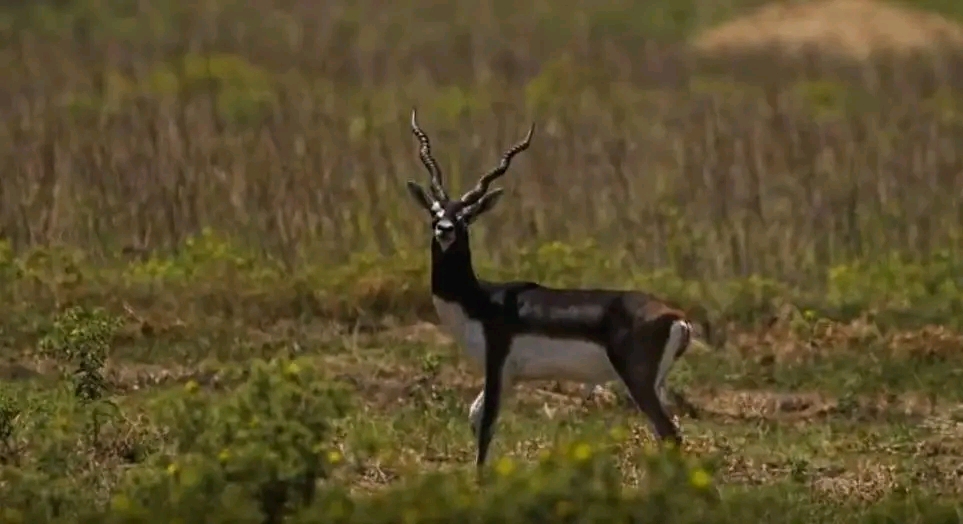
Dholpur, Rajasthan : More than 30 blackbucks have recently been sighted during a wildlife census conducted in the Naka Samona area under the National Chambal Sanctuary, Dholpur.
The blackbuck is an important and sensitive species of the grassland ecosystem, and its presence indicates a healthy ecological environment in the region.

The blackbuck is a medium-sized and highly attractive antelope species, showing clear sexual dimorphism. Adult males range in color from dark brown to black and possess distinctive spiral horns, while females are light yellowish-brown in color and generally hornless.
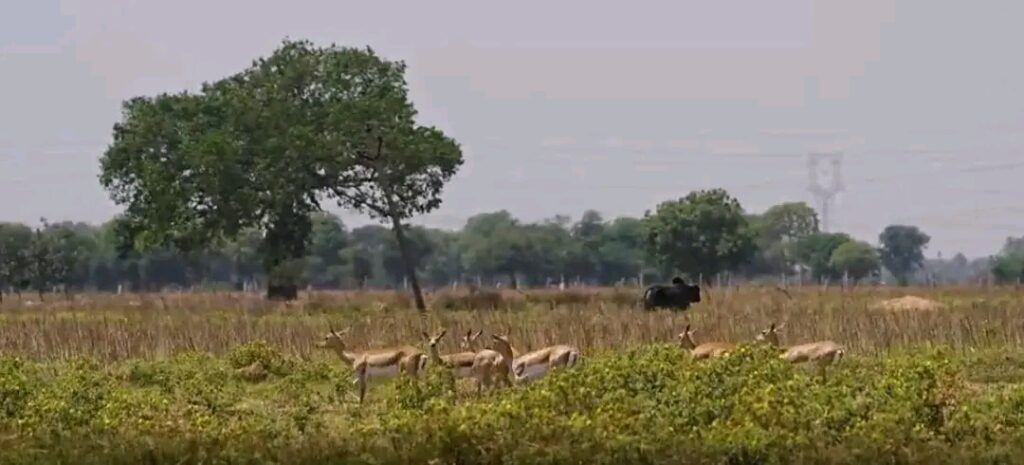
This species is mainly found in grasslands, scrublands, and semi-arid regions, with a preference for open plains. It is a diurnal and herbivorous species that primarily depends on grasses and tender vegetation for food. Blackbucks generally live in groups, the size of which varies depending on seasonal conditions and food availability.
Historically, blackbucks were widely distributed across Rajasthan, but currently they are found only in limited and fragmented habitats. However, due to conservation efforts, an increase in their population has been recorded in some areas.
Apart from blackbucks, other antelope and deer species such as nilgai, chital, sambar, four-horned antelope, and chinkara are also found in the Dholpur region and the National Chambal Sanctuary, enriching the biodiversity of the area.
The Forest Department has been making continuous efforts for wildlife conservation in the sanctuary through regular patrolling, control of illegal hunting, habitat protection, development of water sources, and cooperation with local communities. As a result of these sustained efforts, the reappearance and conservation of sensitive species like the blackbuck have become possible.
This observation not only reflects the ecological quality of the sanctuary but also indicates that the return of rare species is possible through proper conservation and management. The Forest Department will continue such conservation efforts in the future as well.