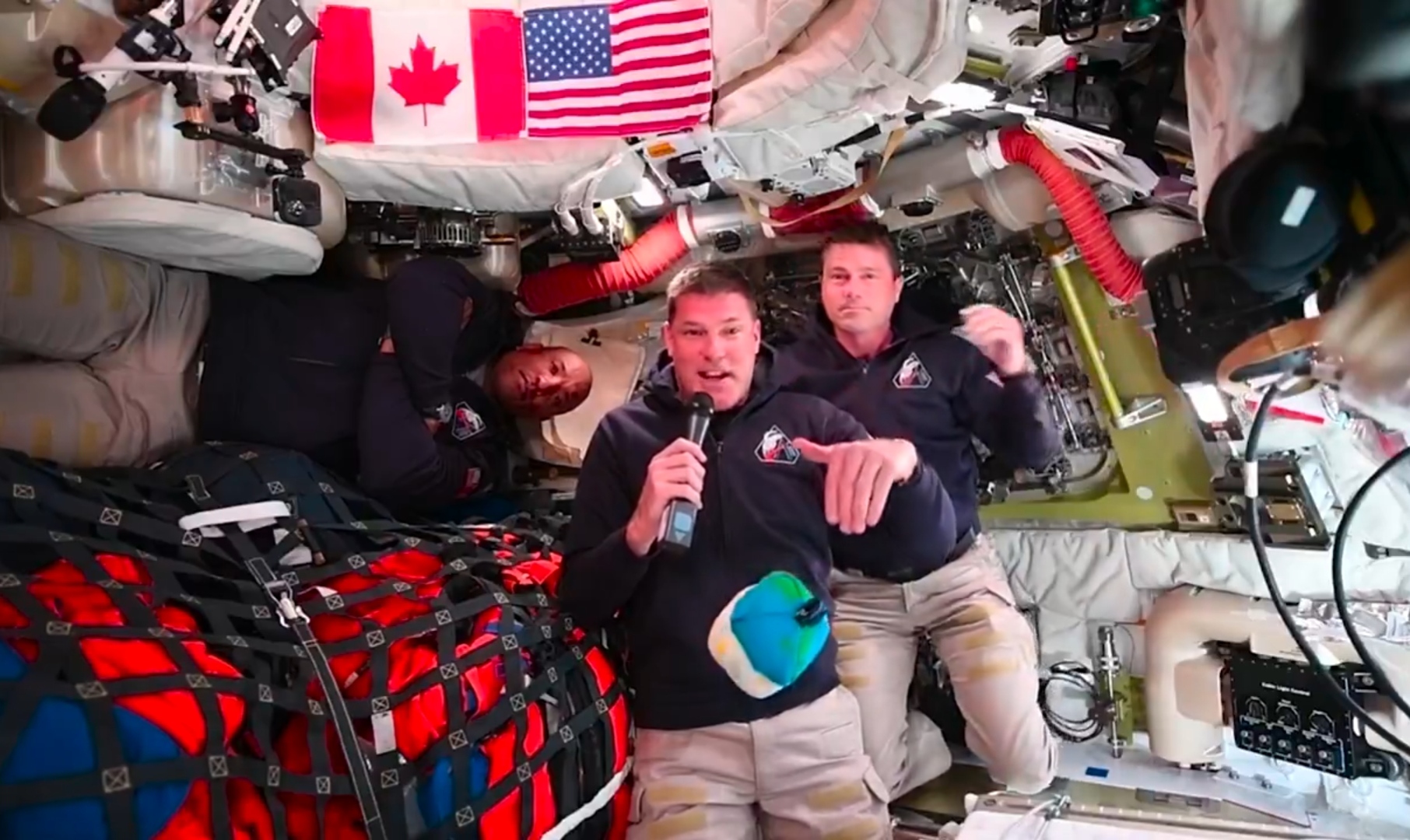
NASA’s Artemis II Mission – In a landmark moment for space exploration, NASA’s Artemis II mission has successfully carried humans close to the Moon for the first time in nearly five decades. On April 7, a crew of four astronauts—Reid Wiseman, Victor Glover, Christina Koch, and Jeremy Hansen—traveled around the Moon, marking a major step forward in humanity’s return to deep space.
According to Indian Standard Time, the spacecraft completed its lunar flyby at around 12:15 AM, offering a breathtaking view of our closest celestial neighbor.


Not a Landing, But a Critical Step
Unlike earlier missions, the Artemis II crew did not land on the Moon. Instead, they performed what scientists call a “lunar flyby,” orbiting around it while remaining inside their spacecraft.
The mission used NASA’s advanced Orion spacecraft, which has now been tested deeper in space than ever before. This mission lays the groundwork for future expeditions that aim to land astronauts on the lunar surface once again.
Seeing the Moon’s Hidden Side
One of the most exciting aspects of this mission is that astronauts witnessed parts of the Moon that are never visible from Earth—the far side. This region has always remained hidden from direct view, making this journey scientifically and visually significant.


Built-In Safety Through Gravity
A key highlight of the mission is its safety design. Even if the spacecraft’s engines were to fail, the Moon’s gravitational pull can naturally guide the Orion spacecraft back toward Earth. This makes the Artemis II mission one of the safest deep-space human missions ever attempted.
Temporary Communication Blackout
During the journey, communication between the spacecraft and mission control was briefly lost. Around 4:14 AM IST, radio signals were blocked for nearly 40 minutes as the spacecraft passed behind the Moon. This is a known and expected phenomenon during such missions.
Breaking a 1970 Record
The Artemis II mission has surpassed a long-standing record set by Apollo 13 mission in 1970, which had reached a distance of 400,171 kilometers. Artemis II has now traveled even farther, setting a new benchmark in human spaceflight.
An Emotional Moment in Space
After achieving this milestone, the astronauts requested permission to name two newly observed lunar craters. One was proposed to be called “Integrity,” after their capsule, while the other was named “Carol” in memory of Commander Reid Wiseman’s late wife, who passed away in 2020 after battling cancer.
The moment turned emotional as Wiseman was moved to tears. The crew shared a heartfelt embrace, reflecting the human side of this extraordinary mission. Later, Wiseman described the view from space as “absolutely stunning.”
A Step Toward Future Moon Landings
The success of Artemis II is more than just a milestone—it’s a foundation. NASA’s next goal is to send astronauts back to the Moon’s surface, something that hasn’t happened since the Apollo era.
This mission proves that humanity is ready to take the next giant leap once again.
FAQs About NASA Artemis ll Mission –
NASA’s mission where astronauts will orbit around the Moon.
Yes, it surpassed Apollo 13’s 400,171 km distance record.
April 1, 2026
India is not directly involved, but the mission has global significance.
Orion spacecraft.